




A bowl left on a stone step, a suncatcher wired to a fence post, a panel leaning against a shaded wall — these are the pieces that fail first. Not because glass is fragile in general, but because water finds the one place it can sit, freezes, and pushes everything around it apart. The good news is that outdoor glass art is a solved problem when you buy and install it with frost in mind. What follows is what actually holds up in a garden that sees hard winters: which glasses tolerate thermal shock, which finishes survive ultraviolet light and ice, and how to fix a piece so the weather works with it instead of against it.
What Frost Really Does to Glass
Winter damages glass in three ways, and only one of them is about the glass itself.
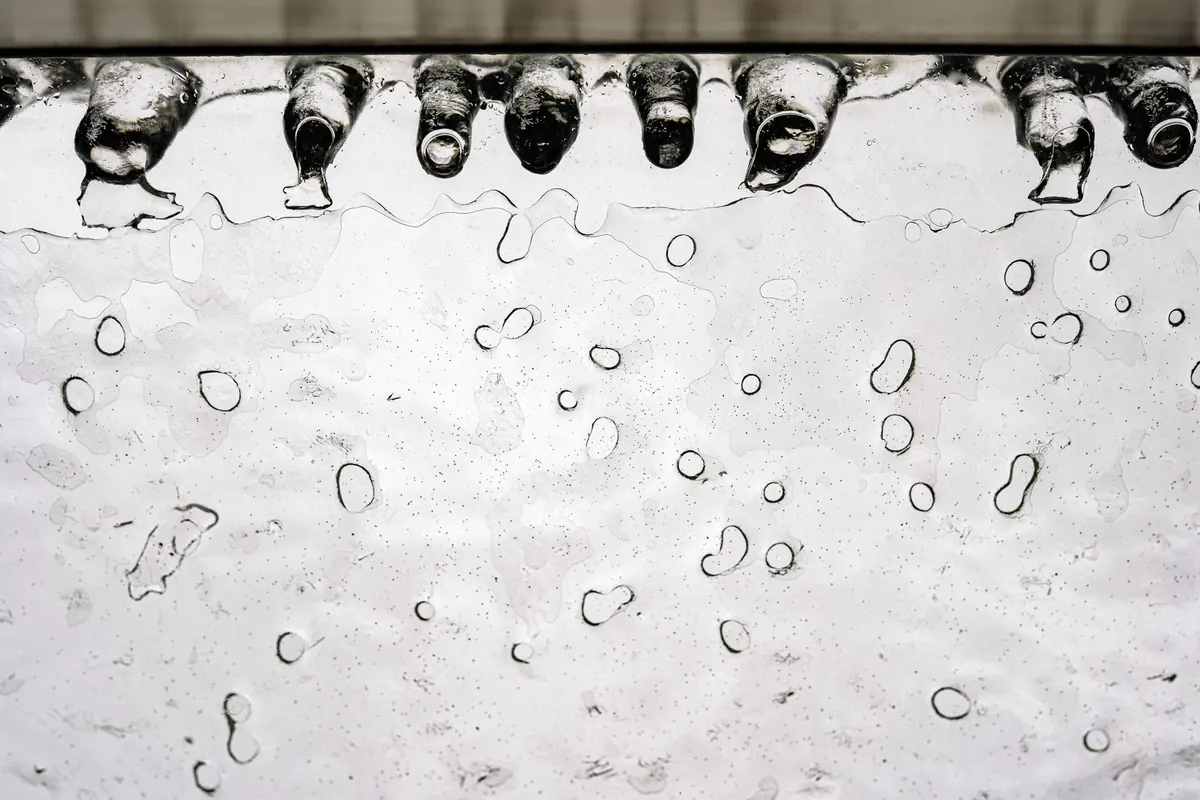
The first is water. Water expands when it freezes, and it will happily freeze in a hairline gap between a glass edge and a metal frame, inside a hollow base, in a drilled hole that was never sleeved, or in a shallow depression cast into the piece. Repeat that expansion and contraction twenty times in a season and joints open, seals fail, and small chips become long cracks. Any design that traps water is a design that will fail, no matter how thick the glass is.
The second is thermal shock. Glass handles compression well and tension badly. A cold winter morning with low sun on one face of a piece, while the other face stays at air temperature, sets up exactly that kind of uneven stress. Most garden glass survives this comfortably; thin glass, glass with sharp edges, and glass with trapped internal stress do not. Dark-coloured pieces in full sun are the most exposed, because they absorb heat fast and then chill fast at dusk.
The third is ground movement. Freeze-thaw cycles lift and settle soil, which is why a piece staked straight into a bed often ends up leaning, twisting or cracking at the point where a rigid stem meets a moving base.
Glass Types That Earn Their Place Outdoors
Tempered (toughened) soda-lime glass
The workhorse for panels, screens, table tops and larger flat elements. Tempering puts the surfaces into compression, which makes it several times stronger than ordinary glass and, importantly, makes it break into small blunt chunks rather than long blades. Two things to remember: it cannot be cut, drilled or ground after tempering, so every hole and edge must be specified beforehand, and a damaged edge can cause a delayed break, sometimes months later. Inspect edges after installation and handle pieces by the faces, not the corners.
Borosilicate glass
Low-expansion glass, the same family used for laboratory ware and oven dishes. Its resistance to thermal shock is its selling point, which makes it the right choice for slender, intricate or flame-worked pieces — thin stems, small sculptural forms, delicate hanging elements. It costs more, and it is not tougher against impact than soda-lime, so it still needs a soft landing area beneath it.
Cast and kiln-formed glass
Thick cast pieces have real mass and generally handle cold well, but they must be properly annealed by the maker. A piece that was cooled too quickly carries internal stress and may crack in its first cold snap, sometimes with no visible cause. Cast forms also tend to have recesses, so ask about drainage before you buy. Fused work in several layers deserves the same question: good annealing, no glued-on additions, no trapped air pockets near an edge.
Panels made with lead came or copper foil
Traditional stained glass is beautiful and poorly suited to exposed positions. Lead creeps and fatigues under its own weight, solder joints crack, and water sits in the channel. Under a porch roof or in a sheltered courtyard it can last for decades; screwed to an exposed fence, it is a short-lived decoration.
Honest alternatives
Where breakage is a real risk — a play area, a busy path, a piece that overhangs paving — cast acrylic or polycarbonate does everything glass does except scratch resistance and permanence. It will not shatter, it tolerates frost, and it yellows over years in strong sun. There is no shame in using it in the places where glass would eventually injure someone.
Edges, Finishes and Colour
Edges matter more than most buyers realise. A ground and polished edge resists chipping; a sharp, fire-polished or roughly cut edge gives cracks a place to start. If a piece has drilled holes, they should be smooth and slightly larger than the fixing that passes through, and they should never be the tightest part of the assembly.
Sandblasted and etched surfaces look wonderful outdoors and hold up well, but a deep blast creates a surface that holds water and dirt. In a hard frost, repeated freeze-thaw on a saturated matte surface can flake tiny shards. A light etch or a sealed blast is the safer choice for horizontal surfaces; vertical panels are far less exposed.
Colour is where cheap pieces give themselves away. Kiln-fired enamels and glass that is coloured in the melt hold their colour for years. Cold paints, decals and vinyl films peel and fade, and — more seriously — anything glued on creates a water trap and an adhesive joint that will not survive a freeze-thaw cycle. Avoid glued-on leaves, beads, hooks and bases entirely. Choose lighter tints for sun-facing positions and reserve dark, saturated pieces for shade.
Hardware, Drainage and Movement
Most failures blamed on glass are really failures of the fixing. A few rules cover nearly every situation:
- Use stainless steel, preferably grade 316 near the coast, or well-coated steel. Plain zinc-plated fittings rust through within a few seasons.
- Keep dissimilar metals apart. Copper against aluminium, or bare steel against stainless, invites galvanic corrosion that quietly eats the joint.
- Never let metal touch glass directly. Nylon, EPDM or silicone pads spread the load and absorb movement.
- Allow a couple of millimetres of clearance in every drilled hole and between glass and frame, so the assembly can expand without loading the glass.
- Give water somewhere to go. Drill weep holes in metal channels, keep recesses open, and never mount a piece in a way that lets it stand in a puddle.
- Use neutral-cure silicone rather than acetic-cure sealant near metal, and avoid rigid epoxy at any joint that will move.
Once a year, in late autumn, walk the garden with a cloth and check every piece: loose fixings, chipped edges, perished pads, water sitting where it should not. That half hour prevents most winter damage.
Installation Methods That Hold Up
Where and how a piece sits decides its life span far more than its thickness. A simple sequence that works:
- Choose a spot with good drainage and some shelter from the prevailing wind. A south or west wall is warmer; a north-facing corner stays frozen longer.
- Prepare a base of compacted gravel or a solid paver rather than bare soil. Set the piece on it, never buried in earth that will heave.
- Fix mechanically — a base plate bolted down, a bracket screwed to a solid wall, a rod sleeved through a cast hole — rather than relying on friction or weight alone.
- Anchor anything taller than about a metre against wind, and remember that a hollow vessel acts like a sail rather than a weight.
- Check the piece after the first hard frost, then again in early spring, and correct any lean or looseness immediately.
Siting deserves a second thought for practical reasons. Keep glass art off mowing lines and away from the edge of a path where a wheelbarrow will find it. If children play barefoot nearby, place breakable pieces where they cannot be reached or choose shatter-friendly materials.
Choosing Well and Living With It
Frost resistance is not a coating or a label; it is a set of decisions made at the bench and at the mounting point. Ask about annealing, about edge finishing, about how water leaves the piece, and about how it is fixed. Vague answers are the warning sign. Then install it slightly higher and looser than instinct suggests, with drainage underneath and soft pads between glass and metal.
Do that, and outdoor glass becomes what it should be: a material that catches winter light and looks better for the frost on it, rather than something you wrap in bubble wrap every November and forget.
Photo: Yan Krukau / Pexels